What Are Swirl Marks and Can They Actually Be Removed?


.png)

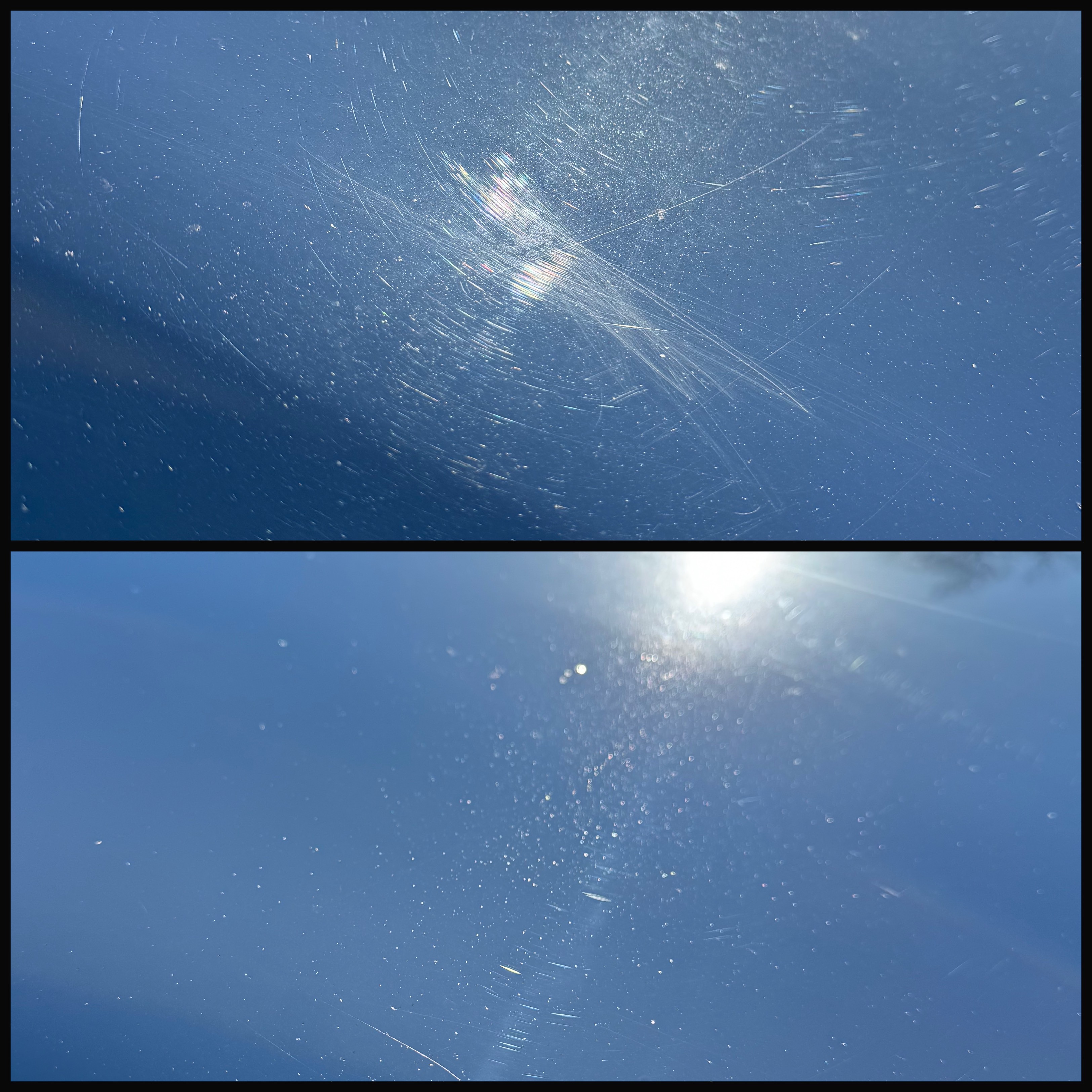
Pull into direct sunlight and look at your hood at an angle. If you see a web of fine circular scratches radiating out from the reflection, those are swirl marks, and almost every car on the road has them.
Here is what causes them, whether they can be removed, and why the answer to that question matters before you spend money on a coating.
What they actually are
Swirl marks are very fine scratches in your clear coat. Individually they are too small to notice. Collectively they scatter light in every direction instead of reflecting it cleanly, and that scattering is what makes paint look hazy, flat, or dull.
They show up most on dark colors, not because dark cars get more of them, but because there is more contrast between the scratch and the surrounding surface. Silver and white hide them well, which is why owners of light-colored cars are often surprised when they finally see them under the right light.
Where they come from
Here is the part that surprises people: the overwhelming majority of swirl marks come from washing, not from driving.
Automatic car washes. The brushes touch every car that goes through. They pick up grit from the vehicle ahead of you and carry it onto yours. This is the fastest way to accumulate swirls.
Single-bucket washing. Dip the mitt, wash a panel, dip the dirty mitt back in the same bucket, repeat. Every dip returns grit to the water, and you are dragging that grit across the paint on the next pass.
Wrong towels. Household towels, old t-shirts, and paper towels are abrasive against clear coat. Drying with them is essentially light sanding.
Dry wiping. Wiping dust off a dry panel drags every particle across the surface. This is one of the most common causes and it happens constantly, because dust looks harmless.
Can they be removed?
Yes, genuinely removed, not hidden. This is what paint correction does.
Correction uses a machine polisher with an abrasive compound to level a microscopic amount of clear coat until the surface around each scratch is brought down to the base of the scratch. The result is a uniform surface again, and light reflects cleanly instead of scattering.
Important distinction: this removes clear coat. It does not add anything. That is why correction is not something to do repeatedly without reason — clear coat is finite, and it is thinner than a sheet of paper.
What glaze and filler products do
Many all-in-one products contain fillers that sit in the scratches and temporarily reduce their visibility. The car looks corrected. Two or three washes later the fillers wash out and the swirls return.
This is why professional correction includes an isopropyl alcohol wipe-down before the result is evaluated. The alcohol strips oils and fillers so you see what the paint actually looks like, not what a product is temporarily hiding.
If a correction result disappears after a few washes, fillers were doing the work.
One-step versus multi-step
One-step uses a single compound and pad combination to cut and finish in one pass. It removes light swirls and restores substantial gloss. It is the right choice for paint in reasonable condition, and it is the best value for most daily drivers.
Two-step or three-step uses a heavier cutting stage first, then progressively finer polishing to refine what the cutting stage left behind. This removes deeper defects but takes considerably more time and removes more clear coat.
An honest shop will tell you when one step is enough. Not every car needs the maximum.
Why this matters before a ceramic coating
This is the practical reason to care.
A ceramic coating is transparent. It does not hide defects — it seals them in and, because it adds gloss, often makes them more visible. A coating applied over swirled paint locks those swirls in for the life of the coating, which can be several years.
Correction before coating is not an upsell. It is the difference between locking in a good finish and locking in a bad one.
Why they can come back
Correction fixes the paint. It does not change what caused the damage. If the car goes back through the same automatic wash, the swirls return.
To keep a corrected finish: hand wash with the two-bucket method, use a grit guard, use quality microfiber and plenty of clean towels, never wipe dry paint, and stay out of brush-style automatic washes. Touchless washes are safer, though they use stronger chemicals.
A quick self-check
Park in direct sunlight or use a bright LED flashlight held close to the paint at an angle. Look at the reflection. Fine circular lines radiating outward are swirls. Straight deeper lines are scratches, which may or may not correct out depending on depth. If you can catch a fingernail in a scratch, it has gone through the clear coat and correction will not remove it.
A ceramic coating is transparent. Applied over swirled paint, it does not hide the defects — it seals them in for years.
Swirl marks are the single most common reason paint looks older than the car. They are also one of the few forms of paint damage that can genuinely be fixed rather than covered.
Big Dog Detail provides paint correction and ceramic coating throughout Greater Chattanooga. If you are considering a coating, correction first is what makes the difference between a good result and an expensive mistake.